Paper in J Mater Chem A

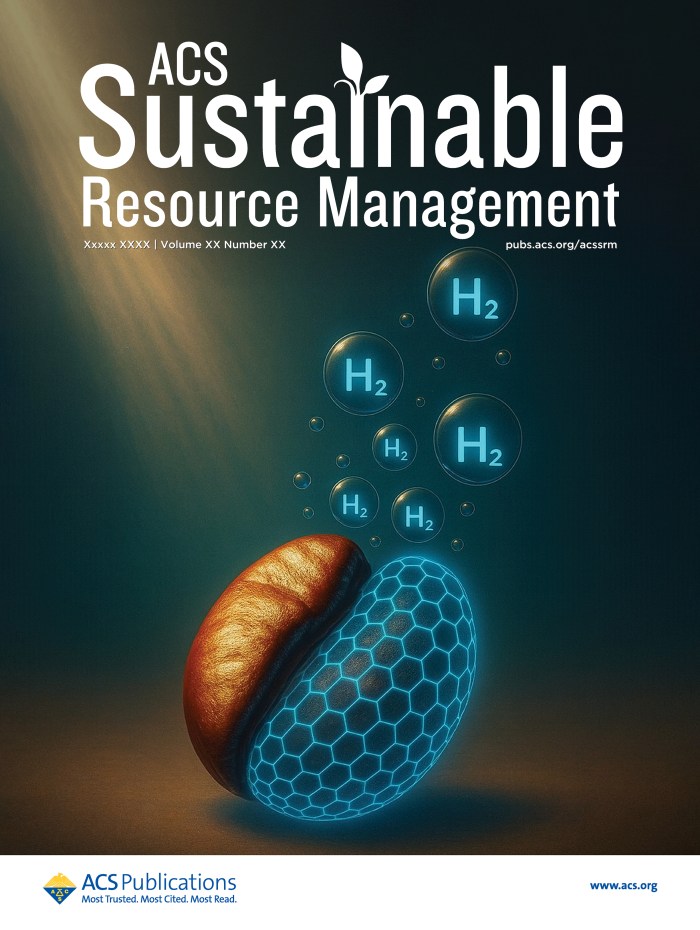
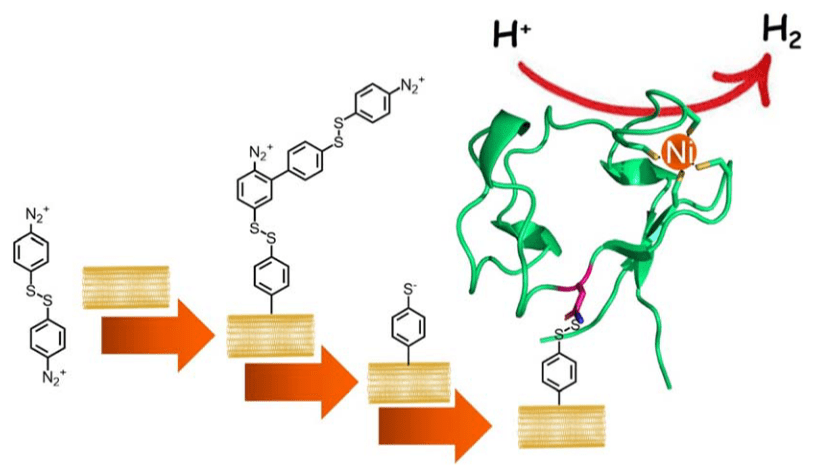
Léonard’s article about an artificial metalloenzyme for hydrogen evolution was published in the Journal of Materials Chemistry A (read his paper here). This paper led by our collaborators Christine Cavazza and Alan Le Goff in Grenoble demonstrates the site-specific attachment of a Rubredoxin protein to a carbon nanotube electrode via diazonium coupling of a thiophenolate. After substituting the Rubredoxin Fe for Ni, the resulting surface-bound artificial metalloenzyme acts as an efficient H2-evolving electrocatalyst with up to 4 mA cm-2 at 800 mV overpotential.

Lab reshuffle

After undertaking his BSc project and working as a research intern, Zaid Wonde leaves the Kühnel Lab after 18 months to continue his studies in microbiology. Nils Weimper leaves the lab after 6 months as a research intern to undertake his MSc project with Fabian Commichau. We will miss you guys!

Taylor Frost starts her interdisciplinary MSc project on photoreforming in collaboration with Sven Marhan in Soil Biology. Ellen Lambur starts as lab technician. Welcome to the Lab!

Atekelte Kassa leaves the lab to undertake a PhD in physics at the University of York.

Paper in Trends in Chemistry

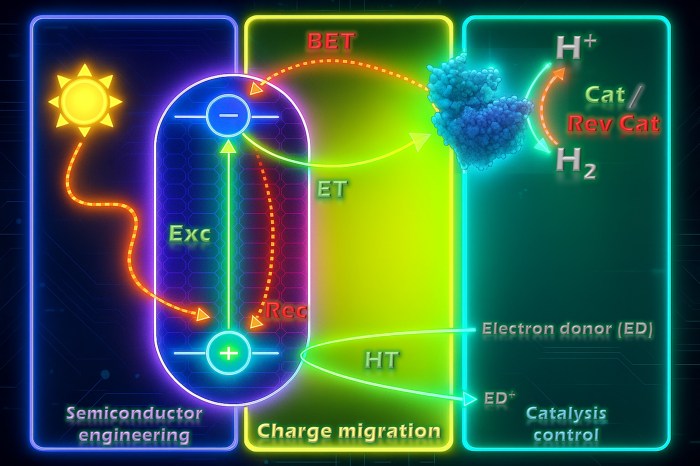
Léonard’s article about the mechanistic details of semiconductor–enzyme hybrid photosystems was published in Trends in Chemistry (read his paper here). The paper highlights exciting work from the Dukovic group at Boulder that examines the various competing electron transfer pathways in biophotocatalysts that are unobservable by direct means. Using kinetic modelling, the work shows how often overlooked pathways such as back electron transfer and reverse reactions are key for achieving a high activity (read original paper here).

Paper in Nature Chemistry

After a long review process, our joint paper with the Kornienko Lab in Bonn was finally published in Nature Chemistry (read paper here). The first experiments were performed by Max Kutter back in 2018! The paper shows how a mediocre homogeneous catalyst was turned into a highly active hetrogeneous electrocatalyst for CO2 reduction through the use of fluorine chemistry. Making a molecular cobalt terpyridine catalyst highly hydrophobic enables it to self-assemble on the surface of a gas-diffusion electrode, which alters its product selectivity from CO formation to the selective formation of CH4 at high current densities. We show that in this environment, proton transfer occurs via terpyridine ligands serving as a proton conduit. Free access to the paper is available here.

Moritz gives introductory interview

Moritz gives a detailed introductory interview to the University Press Office about his research and teaching career and motivation. Read the full interview here (Unfortunately, the interview is only available in German)

Additionally, we offer you an Instagram interview featuring a subtitled video that is accessible here: https://www.instagram.com/p/C-KOxpzsEjF/