
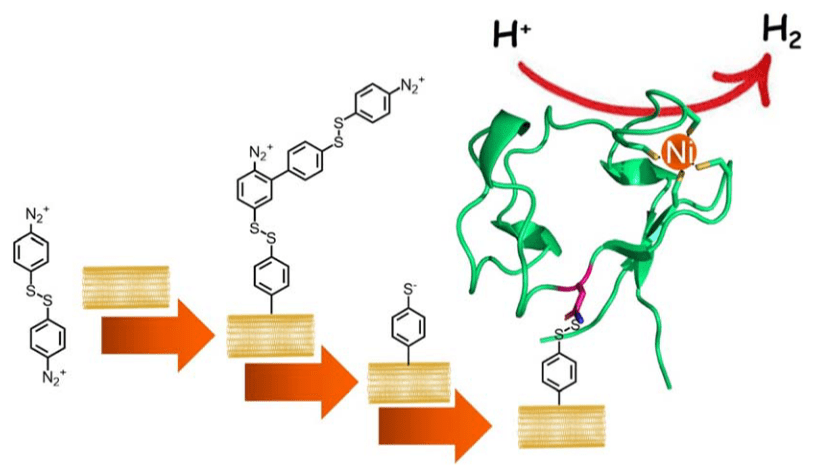
Léonard’s article about an artificial metalloenzyme for hydrogen evolution was published in the Journal of Materials Chemistry A (read his paper here). This paper led by our collaborators Christine Cavazza and Alan Le Goff in Grenoble demonstrates the site-specific attachment of a Rubredoxin protein to a carbon nanotube electrode via diazonium coupling of a thiophenolate. After substituting the Rubredoxin Fe for Ni, the resulting surface-bound artificial metalloenzyme acts as an efficient H2-evolving electrocatalyst with up to 4 mA cm-2 at 800 mV overpotential.
 Kühnel Lab